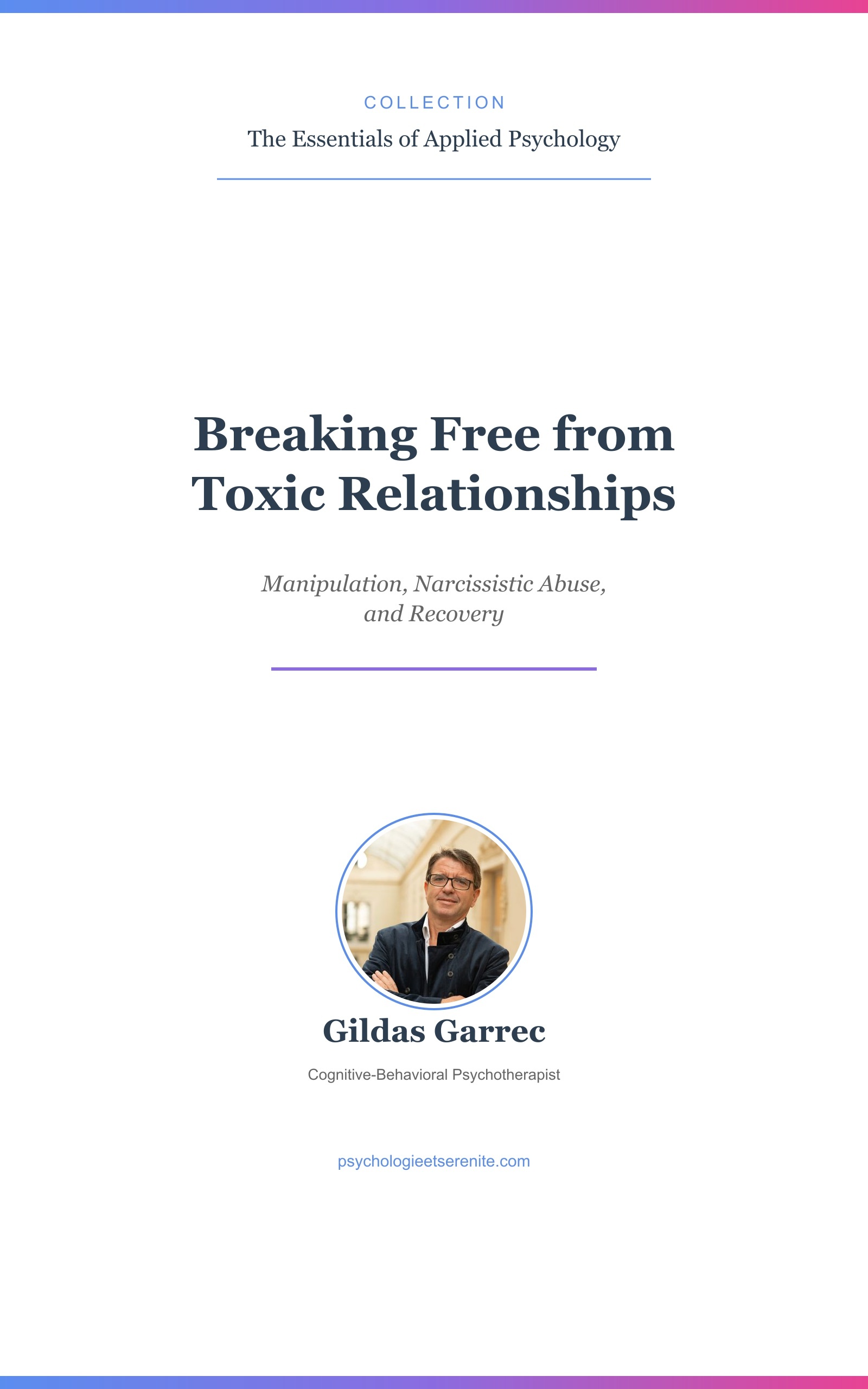
Breaking Free from Toxic Relationships
Recognise it, break free, rebuild yourself
By Gildas Garrec · 240 pages · 2025
About this book
Understand manipulation, gaslighting and coercive relationship patterns. A guide to recognizing harmful dynamics, setting boundaries and rebuilding self-esteem.
Do you feel trapped in a relationship that's destroying you? You apologize constantly, doubt your own perceptions, no longer recognize the person you were before meeting them? This clinical guide decodes the mechanisms of relational control — manipulation, gaslighting, trauma bonding, love bombing followed by intermittent reinforcement — across eight chapters that move from spotting the ten warning signs to rebuilding after the relationship ends, covering the narcissistic manipulator profile along the way. Written by a practitioner specializing in Cognitive Behavioral Therapy (CBT), it draws on real anonymized clinical cases and recent research in relationship psychology (Kaighobadi et al., 2024) to show that relational toxicity isn't just a feeling — it's a documented, measurable phenomenon. You'll learn to tell a healthy conflict apart from a control dynamic, break free of constant self-blame, and guard against relapsing into a new toxic pattern — a path toward rebuilding self-esteem and independence, not just a list of tips.
Table of contents
- 1Defining the Toxic Relationship
- 2The Difference Between Healthy Conflict and a Toxic Relationship
- 3The Spectrum of Toxicity
- 4The Ten Warning Signs
- 5Scientific Research on Toxic Relationships
- 6Why Is It So Difficult to Recognize a Toxic Relationship When You Are Living It?
- 7Returning to Nathalie's Case
- 8PRACTICAL EXERCISE: The Warning Signs Journal
- 9Key Points of Chapter 1
- 10What Is Trauma Bonding?
- 11The Neurochemistry of Trauma Bonding
- 12Intermittent Reinforcement: The Heart of the Trap
- 13Why Victims Stay: Beyond Neurochemistry
- 14Echo and Narcissus: A Two-Way Dependence
- 15The Physiological Cost of Trauma Bonding
- 16Returning to Sebastien's Case
- 17PRACTICAL EXERCISE: The Emotional Map
- 18Child Witnesses: The Silent Victims of Trauma Bonding
- 19Key Points of Chapter 2
- 20Origins of the Term
- 21Defining Gaslighting
- 22The Eight Techniques of Gaslighting
- 23Institutional and Cultural Gaslighting
- 24The Impact of Gaslighting on Mental Health
- 25Subtle Forms of Gaslighting: Beyond the Obvious
- 26How to Recognize That You Are a Victim of Gaslighting
- 27Returning to Camille's Case
- 28PRACTICAL EXERCISE: The Reality Journal
- 29Key Points of Chapter 3
- 30The Four Phases of the Coercive Control Cycle
- 31The Karpman Drama Triangle: Understanding Relational Roles
- 32How Manipulators Choose Their Targets
- 33Cognitive Distortions Maintained by the Abuser
- 34Returning to Amina's Case
- 35PRACTICAL EXERCISE: Identifying My Role in the Karpman Triangle
- 36Key Points of Chapter 4
- 37Bibliographic References for Chapters 1 to 4
- 38Understanding Pathological Narcissism
- 39DSM-5 Criteria: Narcissistic Personality Disorder
- 40Grandiose Narcissism Versus Vulnerable Narcissism
- 41The Narcissistic Wound: Understanding the Origins
- 42Can a Narcissist Change?
- 43The Trap of Misplaced Compassion
- 44The Question of Co-Parenting
- 45When the Narcissist Is in the Mirror
- 46CBT in Service of Coercive Control Victims
- 47The Cognitive Model Applied to Toxic Relationships
- 48Cognitive Distortions Maintained by the Manipulator
- 49The ABC Model: Understanding the Link Between Events, Beliefs, and Consequences
- 50Behavioral Activation: Rebuilding a Life
- 51The Therapeutic Journal: A Daily Ally
- 52Cognitive Defusion: Detaching from Toxic Thoughts
- 53When CBT Is Not Enough
- 54The Time for Rebuilding
- 55Rebuilding Self-Esteem: Jeffrey Young's Schema Model
- 56Relearning Trust: Building Secure Attachment
- 57The Art of Setting Boundaries
- 58Why Victims Fall Back Into the Trap
- 59Warning Signs in a New Relationship
- 60The Role of Attachment Style in Partner Choice
- 61Building a Support Network
- 62Cultivating the Relationship with Yourself
- 63Forgiveness: A Nuanced Question
- 64What This Book Cannot Do
- 65A Message of Hope
- 66When to Consult a Professional
- 67Resources
- 68Scientific References Cited (Chapters 5 to 8)
- 69Reference Works
- 70In the Same Collection
Before reading, assess your situation:
Take the toxic relationship test →